
How business owners can turn a marketing budget into growth that funds itself.
Over the last 20 years I have managed advertising budgets of every size, from $1,500 a month to more than $300,000 a month, and the principle that grows a business is the same at both ends: built the right way, a marketing budget can fund its own growth. You invest what you can, it brings customers back, and you reinvest a share of the profit to reach more of them.
Most business owners think about that budget by the month, but I think about it by the day, because that is how it actually gets spent. Fifteen hundred dollars a month is really just fifty dollars a day, which is enough to prove what works. You can start with a very small budget, test what sells, and scale from there.
Whether you own the business or run its marketing, the shift that matters is the same. A cost is something you cut. An investment is something you measure, manage, and scale, because it brings more back. Done right and powered by AI, your marketing is one of the highest-return investments you can make, because it is one of the few where you control the asset and reinvest the profit. A lot of the attention currently goes to AI, and for good reason. But AI does not compete with your marketing. It makes the return higher: lower acquisition costs, faster testing, better use of every dollar.
Who’s making this case
I’m David Orion Álvarez, founder of Roi Room. I have spent more than 20 years in marketing, 11 of them in Silicon Valley, managing paid media at scale, mostly Google Ads, Bing Ads, and Meta Ads, for public companies, technology unicorns, and small businesses. Most of that experience is in the United States, with additional experience in Latin America, Europe, and Asia-Pacific. Over those two decades I have managed millions of dollars in ad spend, around a million a year, with high returns.
My focus has always been the same: turning a marketing budget into more leads, sales, and growth. Roi Room is built around that idea, with our headquarters in Miami and our team in Medellín.
The virtuous cycle: growth that funds itself
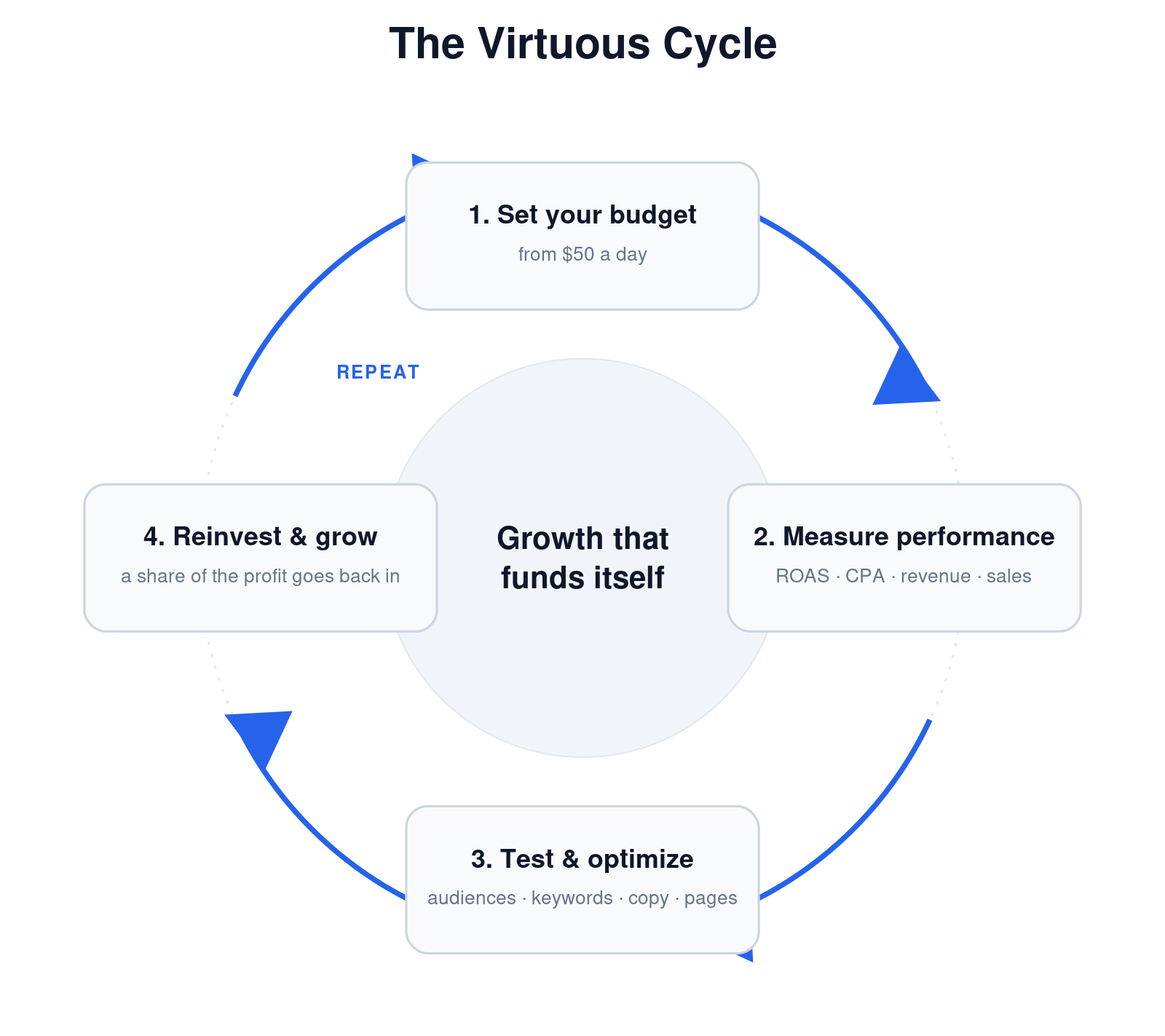
Here is the whole loop, step by step:
- Set a budget.
- Drive targeted traffic to your offer.
- Turn that traffic into leads and sales.
- Measure the cost and the return.
- Run new tests and optimize what works.
- Reinvest a share of the profit.
- Do it again, reaching more of the right people.
Here is how it actually works, step by step. It starts with an initial budget. That budget generates a return on ad spend and real performance data: cost per acquisition, revenue, sales. We read that data and test and optimize the campaigns against your business goals. That optimization produces growth, and growth gives you a choice: increase the budget by reinvesting a percentage of the profit the advertising generated, or keep the budget where it is and cash out the rest of the profit. Either way, the cycle repeats, starting again from the budget.
That is the whole point. You grow the business without pulling more money out of your own pocket, because growth is funded by a percentage of the profit the campaigns already produced. The system becomes self-sustaining, and that is the part most owners have never seen work firsthand.
This cycle works when you already have traction. That means at least some sales proving that what you offer actually sells, and a way to close, whether that is a sales team, phone calls, WhatsApp, or a form. You do not need a lot of sales. I have scaled businesses that started with very few sales but a proven offer, because a proven offer with early traction is already a business in the making. Paid advertising does not create demand from nothing. What it does is take something that already works and put it in front of far more of the right audience.
Turn your business into a growth engine
You are already investing in your business every month. You pay for inventory or software, staff, equipment, space, and rent. All of that is money you put in before a single new customer shows up.
Marketing is the one investment that goes out and brings those customers in. It is what turns everything else you already pay for into revenue. The rest of your spending gets you ready to serve customers. Marketing is what puts your offer in front of more of the right ones.
That is what makes a business a growth engine, and it is an engine you own. You do not have to feel certain about the future to start it, and you do not have to keep pulling money from your own pocket. What it takes is an offer that already sells. When that is true, putting a controlled amount behind the one asset you understand best and run yourself is one of the highest-return moves available to you.
It is a structural advantage in where the money is working and who is controlling it. That is not the same as a guaranteed return, and no responsible marketer would promise you one. But an asset you control, with profit you decide how to reinvest, is one of the strongest positions an investor can be in.
Start small, then scale what works
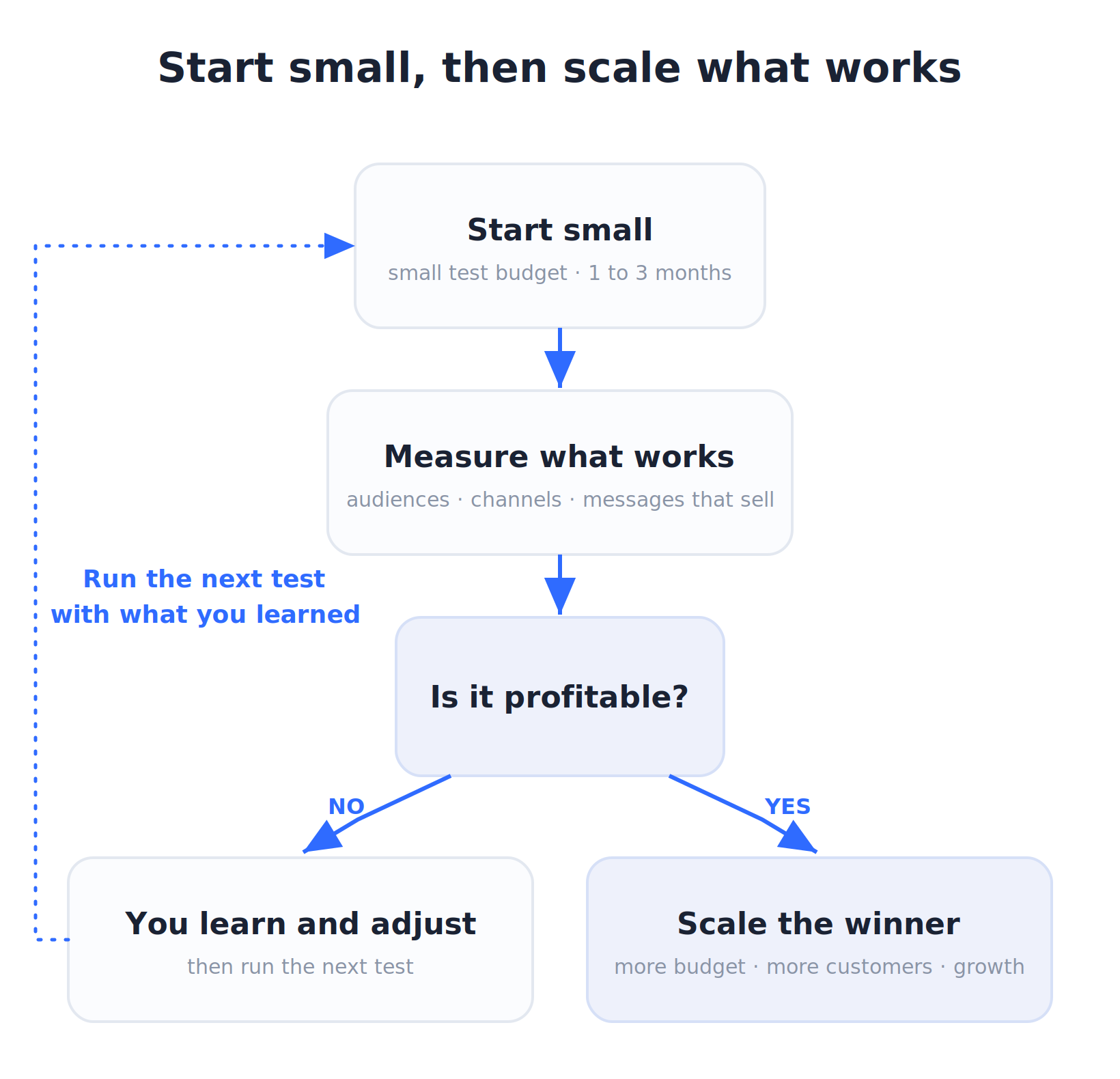
Starting is low risk, since the investment is very small. We usually begin with a short test, one to three months on a small budget, built to answer a single question: which audiences, channels, and messages actually turn into sales for your business.
That keeps your risk low while we gather real data. If the numbers do not add up, you have spent very little to learn it. If they do, you have found something worth scaling: a channel where a controlled amount of spend brings back more than you put in. That is when a small test turns into real growth, because you already know what works and you simply put more behind it.
AI makes the cycle spin faster
Two things are happening at once, and both work in your favor.
First, the platforms themselves keep getting smarter. Google Ads, Meta, and the rest now run on AI by default, and that AI keeps improving constantly. Automated bidding, audience modeling, and creative testing that used to take a team are now built into the rails. But that AI only optimizes toward the goal you point it at, with the data and the budget you give it. Pointed at the wrong goal, it gets you to the wrong place faster. The strategy, the margins, and the definition of a profitable sale still have to come from someone who understands your business.
Second, we use AI inside our own process. For every client we keep a dedicated Claude workspace that holds their full context: their business DNA, their goals, their margins, and how their campaigns have performed. So when we analyze an account, the AI is not working in a vacuum, it is reading the numbers inside the context of that specific business. That lets us spot patterns across thousands of search terms, see which audiences and creatives actually drive profit, and make sharper optimization decisions than a generic dashboard ever could. The result is faster optimization, lower acquisition costs, and more of every dollar going toward what works.
The platform AI raises the floor. Our AI raises the ceiling. Together they make the same budget compound faster.
Growth hacking: how we find what works fast
A big part of that return comes from a methodology called growth hacking, a term coined by Sean Ellis, the first marketer at Dropbox. The core idea is simple: instead of betting everything on one guess, you run a high tempo of small experiments, learn fast from real data, and put more behind whatever wins.
I started working seriously with this method back in 2015. I was a regular at the SF Agile Marketing meetups, often hosted at Zendesk, and at one of them I got to see Sean Ellis present his approach in person. That talk is where high-tempo testing really clicked for me.
In practice, that means we almost never launch a single campaign and hope it works, because hoping is not a strategy. We launch two or more variations at once, testing audiences, keywords, copy, and landing pages, and we let the results tell us which one performs best. We test heavily in the early phase, when each lesson is worth the most, and we keep testing constantly after that. Every experiment either lowers your cost per acquisition or shows us where not to spend, and both make your budget work harder.
You’re the investor. We manage the money.
Let me be clear about roles: you are the investor. It is your capital, your business, and your upside. Our job is to manage that capital and deploy it where the return is highest, the way a fund manager works a portfolio, except here the asset is a business that already sells. We win when you win.
We focus on self-sustainable growth through paid advertising. We build and execute paid advertising strategies against your goals, which are usually:
- Increase sales
- Maximize profit
- Generate leads
- Expand into new markets
This works whether you are just starting or already running large campaigns. When a business comes to us already spending, say, $50,000 a month across channels, we do not tear down what is working. Often an older campaign that is performing decently is worth more than something brand new. We keep what works, launch new tests alongside it, and clean up the account: adding negative keywords, cutting waste, and optimizing the structure piece by piece. The goal is the same at every budget level, get more return out of every dollar and reinvest it into growth.
One of the most important things we do is target the right audiences in the right channels, so we maximize your return on investment. Our core metrics, the ones we believe actually grow a business through paid advertising, are cost per acquisition (CPA), return on ad spend (ROAS), and lifetime value.
If you know your margins and your average sale, the math gets simple. Say you sell at $100 with a 40% margin. That means you can spend up to $40 to win a sale and still break even, so any sale that costs less than $40 is profit. The key number is cost per sale, not just cost per lead, because not every lead buys. If leads cost you $6 and one in three becomes a customer, your real cost per sale is $18. As long as that stays well under your $40 limit, the difference is profit you can reinvest or take home, and that is how the cycle keeps feeding itself.
I will be honest about measurement. In lead generation we can track cost per lead and ROAS with precision, but the final return on investment depends on your margins and how well you close. That is why we work with your numbers, not generic benchmarks.
The main channels we use are Google Ads and Bing Ads, because there the customer already has intent in their search. Then we add social channels like Meta Ads to reach the right audiences where they spend their time. We deploy your budget where the return is highest, measure every dollar, and reinvest what works.
Focusing on one metric at a time
One principle shapes how I run a campaign. When two important metrics pull against each other, like the number of leads and the cost per lead, trying to perfect both at the same time usually means each one improves more slowly than it would on its own. So we choose one metric to focus on for a set period and set a limit on the other. If you need volume early on, we focus on growing the number of leads and accept a higher cost per lead for a few weeks. Once the lead flow is healthy, we shift focus and bring the cost per lead down. I learned this approach from SC Moatti in a course she taught through Stanford Continuing Studies, and it has worked consistently for us.
What this looks like in real numbers
Here is one recent example. A law firm in Panama came to us wanting more clients. We built and ran the paid campaigns, tested, and optimized against the leads that mattered. In one month, compared to the same month a year earlier:
- Website sessions went from 228 to 2,867, about twelve times more traffic.
- Lead form submissions went from 0 to 90.
- WhatsApp contacts from potential clients went from 3 to 185.
On the ad side that month, the campaigns drove 219 conversions at an average of about $1.71 per click and a conversion rate near 15 percent, on roughly $2,500 in spend. For a law firm, that is a pipeline of new cases for a fraction of what a single client is worth.
Earlier in my career I ran the Amazon ad account for an eCommerce company in the San Francisco Bay Area. We grew monthly sales by 500 percent and reached a 1,471 percent return on ad spend, which means $14.71 back for every dollar we put in. Same principle, different business: put money behind an offer that already sells, measure everything, and reinvest what works.
Ready to put your budget to work
If you already have traction and a way to close, your marketing budget can become one of the highest-return investments you control. Let us show you where it would go and what it could return.
Get your free proposal at roiroom.com/free-proposal/
Author